展示如何使用各種特徵的 QSerialPort .
終端 展示如何為簡單串行接口創建終端使用 Qt Serial Port .
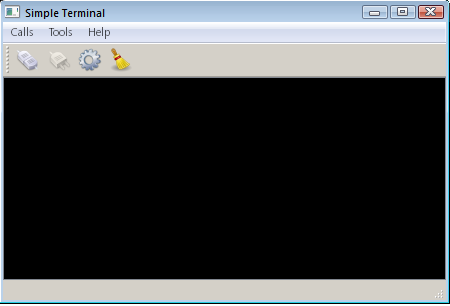
This example shows the main features of the QSerialPort class, like configuration, I/O implementation and so forth. Also, the class QSerialPortInfo is invoked to display information about the serial ports available in the system.
QSerialPort 支持 2 種常規編程方式:
waitFor...()
functions can be called (i.e.
QSerialPort::waitForReadyRead
()) to suspend the calling thread until the operation has completed.
In this example, the asynchronous approach is demonstrated. The 阻塞從屬 example illustrates the synchronous approach.
我們的範例包含一些 GUI 小部件:
串口被實例化在 MainWindow constructor. The main widget is passed as the parent, so the object deletion happens automatically according to the parent and child mechanism in Qt:
MainWindow::MainWindow(QWidget *parent) :
    QMainWindow(parent),
    m_ui(new Ui::MainWindow),
    m_status(new QLabel),
    m_console(new Console),
    m_settings(new SettingsDialog),
    m_serial(new QSerialPort(this))
{
    ...
    m_serial(new QSerialPort(this))
僅 QSerialPort signal invoked in this example is readyRead() , which shows that new data has been received and hence available:
    ...
    connect(m_serial, &QSerialPort::readyRead, this, &MainWindow::readData);
    ...
}
點擊
Connect
按鈕援引
openSerialPort()
槽:
void MainWindow::openSerialPort()
{
    const SettingsDialog::Settings p = m_settings->settings();
    m_serial->setPortName(p.name);
    m_serial->setBaudRate(p.baudRate);
    m_serial->setDataBits(p.dataBits);
    m_serial->setParity(p.parity);
    m_serial->setStopBits(p.stopBits);
    m_serial->setFlowControl(p.flowControl);
    if (m_serial->open(QIODevice::ReadWrite)) {
        m_console->setEnabled(true);
        m_console->setLocalEchoEnabled(p.localEchoEnabled);
        m_ui->actionConnect->setEnabled(false);
        m_ui->actionDisconnect->setEnabled(true);
        m_ui->actionConfigure->setEnabled(false);
        showStatusMessage(tr("Connected to %1 : %2, %3, %4, %5, %6")
                          .arg(p.name).arg(p.stringBaudRate).arg(p.stringDataBits)
                          .arg(p.stringParity).arg(p.stringStopBits).arg(p.stringFlowControl));
    } else {
        QMessageBox::critical(this, tr("Error"), m_serial->errorString());
        showStatusMessage(tr("Open error"));
    }
}
In this slot, the settings are read from SettingsDialog and an attempt is made to open and initialize the serial port accordingly. If successful, the status bar displays a message that the opening was successful with the given configuration; otherwise, a messagebox is displayed with the appropriate error code and message. If the serial port settings have never been called SettingsDialog , then the terminal attempts to open the port with the default settings: 9600 8N1.
點擊
Disconnect
按鈕援引
closeSerialPort()
槽:
void MainWindow::closeSerialPort()
{
    if (m_serial->isOpen())
        m_serial->close();
    m_console->setEnabled(false);
    m_ui->actionConnect->setEnabled(true);
    m_ui->actionDisconnect->setEnabled(false);
    m_ui->actionConfigure->setEnabled(true);
    showStatusMessage(tr("Disconnected"));
}
In this case, handled by the closure of the serial port.
Typing characters in the console invokes the
writeData()
槽:
void MainWindow::writeData(const QByteArray &data)
{
    m_serial->write(data);
}
This slot sends the characters typed in the given Console widget to the serial port.
When the serial port receives new data, the signal
readyRead()
is emitted, and that signal is connected to the
MainWindow::readData()
槽:
void MainWindow::readData()
{
    const QByteArray data = m_serial->readAll();
    m_console->putData(data);
}
This slot reads the data from the serial port and displays that in the Console 小部件。
點擊
Configure
按鈕援引
show()
槽屬於
SettingsDialog
小部件。
This method displays the SettingsDialog in which the user can choose the desired serial port, see the information about the selected port, and set the desired parameters of the given serial port.
要運行範例從 Qt Creator ,打開 歡迎 模式,然後選擇範例從 範例 。更多信息,拜訪 構建和運行範例 .
文件:
圖像:
另請參閱 阻塞從屬範例 .



