發送數據到 C++ 數據模型和接收數據從 C++ 數據模型。
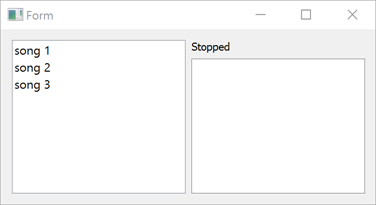
Media Player QML Example (C++ Data Model)
demonstrates how to access data from a C++ data model. The data model enables writing C++ code for
expr
屬性和
<script>
元素。
數據部分
的數據模型後援是子類化的
QScxmlCppDataModel
, for which the Qt SCXML compiler (
qscxmlc
) generates the dispatch methods.
UI 是使用 Qt Quick 創建的。
要運行範例從 Qt Creator ,打開 歡迎 模式,然後選擇範例從 範例 。更多信息,拜訪 構建和運行範例 .
We specify the data model as a value of the
datamodel
屬性在
<scxml>
element in the SCXML file:
<scxml
    xmlns="http://www.w3.org/2005/07/scxml"
    version="1.0"
    name="MediaPlayerStateMachine"
    initial="stopped"
    datamodel="cplusplus:TheDataModel:thedatamodel.h"
The format of the
datamodel
attribute is:
cplusplus:<class-name>:<classdef-header>
. Therefore, we need a file called
thedatamodel.h
that contains a subclass of
QScxmlCppDataModel
:
#include "qscxmlcppdatamodel.h"
class TheDataModel: public QScxmlCppDataModel
{
    Q_OBJECT
    Q_SCXML_DATAMODEL
QScxmlCppDataModel
派生自
QObject
, so we add the
Q_OBJECT
macro in the private section of the definition, right after the opening bracket. We then place the
Q_SCXML_DATAMODEL
macro after
Q_OBJECT
. The macro expands to the declaration of virtual methods, the implementation of which is generated by the Qt SCXML compiler.
In the SCXML file, we specify C++ statements in the
<script>
element and use the
expr
attribute to access the data model:
    <state id="stopped">
        <transition event="tap" cond="isValidMedia()" target="playing"/>
    </state>
    <state id="playing">
        <onentry>
            <script>
                media = eventData().value(QStringLiteral("media")).toString();
            </script>
            <send event="playbackStarted">
                <param name="media" expr="media"/>
            </send>
        </onentry>
        <onexit>
            <send event="playbackStopped">
                <param name="media" expr="media"/>
            </send>
        </onexit>
        <transition event="tap" cond="!isValidMedia() || media == eventData().value(QStringLiteral("media"))" target="stopped"/>
        <transition event="tap" cond="isValidMedia() && media != eventData().value(QStringLiteral("media"))" target="playing"/>
    </state>
The Qt SCXML compiler generates the various
evaluateTo
methods and converts the expressions and scripts into lambdas inside those methods in
mediaplayer-cppdatamodel.cpp
:
bool TheDataModel::evaluateToBool(QScxmlExecutableContent::EvaluatorId id, bool *ok) {
....
    return [this]()->bool{ return isValidMedia(); }();
....
}
QVariant TheDataModel::evaluateToVariant(QScxmlExecutableContent::EvaluatorId id, bool *ok) {
....
        return [this]()->QVariant{ return media; }();
....
}
void TheDataModel::evaluateToVoid(QScxmlExecutableContent::EvaluatorId id, bool *ok) {
....
        [this]()->void{ media = eventData().value(QStringLiteral("media")).toString(); }();
....
}
文件:
